
Is there a Panther Protocol airdrop?
None is announced. Panther pays rewards a different way: activity in its privacy pool earns Panther Reward Points (PRP), and you swap those for ZKP inside the app. The app says it plainly: "zAssets generate Panther Reward Points (PRP), redeemable for $ZKP".
The ZKP token has traded since its sale in 2021. PRP are not a token and can't be sent anywhere. Their value in ZKP floats: "Rewards are paid in PRP, benchmarked against $ZKP through the internal AMM." An old testnet page says "we expect all incentives will be distributed via airdrop" for testers, but we found no later notice confirming such a drop.
What Panther Protocol is
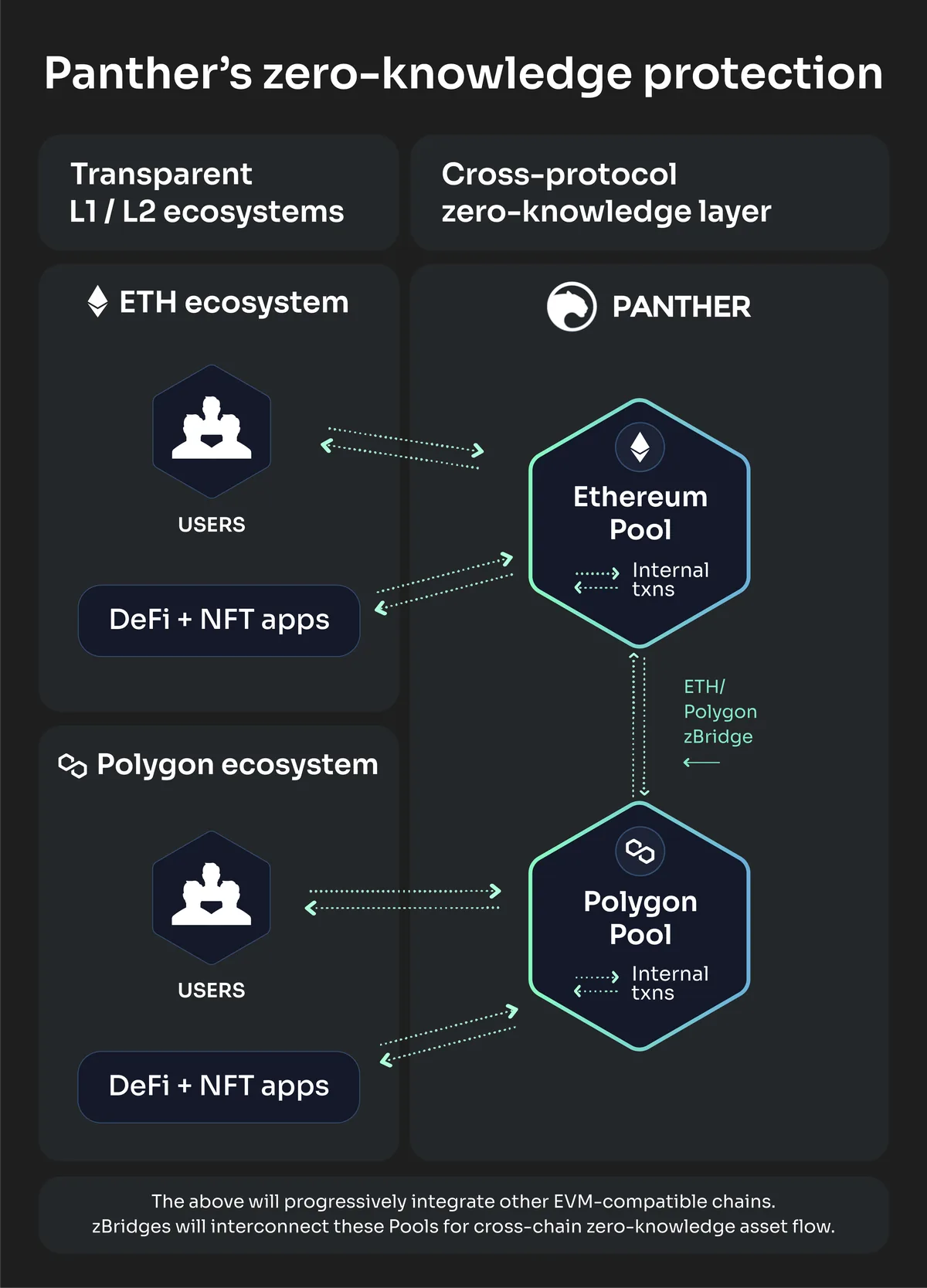
Panther's docs describe it as "A Zero-Knowledge cross-protocol layer unlocking compliant DeFi." You pass a KYC check, deposit approved tokens into a shielded pool, and hold, swap and withdraw them privately. The privacy has limits: encrypted transaction data can be opened for authorities on a formal request, and the app's notice says "Such disclosure does not depend on user initiation or consent."
Mainnet came late. Tokens were sold in 2021, and on 7 May 2026 "Panther Protocol Foundation announced that Panther Protocol is now live on Polygon." Base followed in September after a DAO vote, and on 12 November 2026 the DAO approved Ethereum, to go live once the deployment is done. No Ethereum date has been given.
How Panther Protocol points work
The rules come from DAO votes on Snapshot, called PIPs, and they change. PIP-26 set the main ones for V1: a one-time 1,000 PRP for onboarding, "10% APY on deposited assets (in $ZKP or supported assets), distributed monthly", and small PRP vouchers for running admin tasks. Sends and swaps inside the pool also earn PRP.
PRP stay pending while your deposit sits untouched: "These rewards become available for redemption once you spend these UTXOs." In practice, you redeem after you send, swap or withdraw.
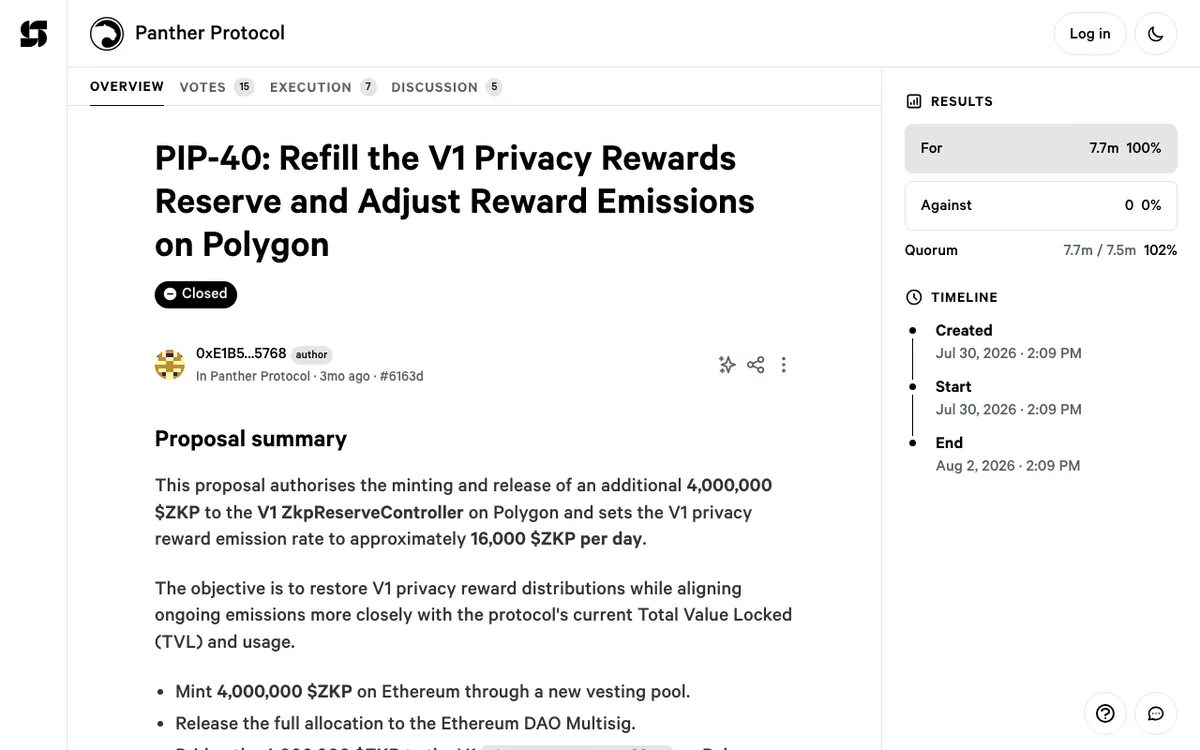
The ZKP behind redemptions is new supply: "Rewards will be sourced from the 450M $ZKP protocol rewards allocation." The first 4 million ZKP for Polygon ran out by late July 2026. A council member explained why: "What we're currently seeing is a 1:1 ZKP:PRP ratio, which is 10x greater than our target." PIP-40 refilled the reserve with 4 million ZKP and cut the payout to about 16,000 ZKP a day. In November, PIP-43 set the same pace for each chain: "At the target rate of 16,000 ZKP per day, 500 days equals 8M ZKP of rewards per deployment."
Panther Protocol airdrop step-by-step guide
No airdrop is announced. These steps follow Panther's docs for earning PRP and redeeming them for ZKP.
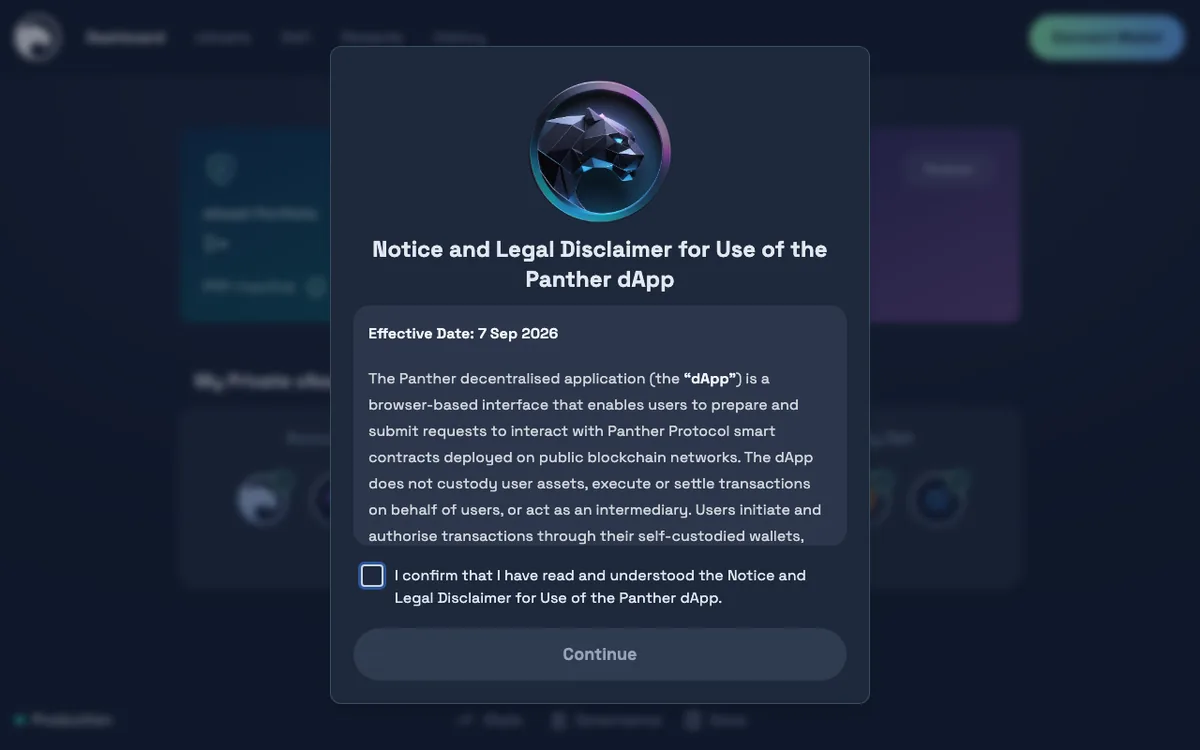
- Open pantherdao.app, the app linked from Panther's X profile, and read the legal notice before you tick it.
- Connect a wallet and pick the network: Polygon or Base for now.
- Complete onboarding and pass KYC with the compliance provider the app sends you to. It checks your ID and runs sanctions screening, and the fee is paid in ZKP.
- Activate your Panther account. Keep a little POL or ETH for gas; the first activation is subsidised. Claim the onboarding PRP under Rewards.
- Deposit an approved token in the zAssets tab. Holding builds pending PRP; sending, swapping or withdrawing makes it available.
Warning You are putting real money into a pool that has been drained before. Deposit only what you can afford to lose, and never enter a seed phrase on any site.
- Redeem available PRP for ZKP in the Rewards tab. Check the rate shown before you confirm, because it moves.
Open the Panther dAppOpens pantherdao.app
Panther Protocol costs and fees
Under PIP-26, the KYC check costs 100 ZKP and the transaction check (KYT) 25 ZKP, paid to the compliance provider. Withdrawals pay a 0.30% protocol fee. You also pay gas and relayer fees; only account activation gets a 200 ZKP subsidy. The PRP that matter most come from deposits, so the program is not free in practice.
Limits per person per day are set by vote: "a deposit limit of $25,000 per day and a withdrawal limit of $100,000 per day". Sending inside the pool is capped at $25,000 a day where it works, and it isn't live on Polygon yet: "A future PIP will be required to activate it on the live Polygon V1 deployment".
Panther Protocol risks and eligibility
- The app is closed to US persons and to people in embargoed or sanctioned places. No full country list is published, and the app blocks some regions.
- "Users must not use a virtual private network, proxy or other means to circumvent applicable access restrictions."
- The Base pool was "drained on 2026-08-06 through a compromised Reality.eth Zodiac module". The DAO minted about 5.1 million ZKP to restore balances.
- Rewards are paid in newly minted ZKP, and the DAO has already cut them once. Votes often pass just over quorum with few voters.
- The DAO "may hold specified upgrade authority over Panther Protocol smart contracts".
- The docs list audits of the token, its vesting and version 0.5. We found no published audit of the V1 contracts.
- "Panther DAO is not registered, licensed, or authorised by any financial regulatory authority in any jurisdiction".
- No minimum age is stated.
Who is behind Panther Protocol?
Panther is run by Panther DAO, which votes with ZKP on Snapshot. Its council members mostly post under forum names; the one named person we found is Anish Mohammed, confirmed to the emergency stop committee by PIP-29. Panther Protocol Foundation, a non-profit in Zug, Switzerland, announced the Polygon launch but says: "The Foundation does not operate the protocol, deploy smart contracts, host interfaces, custody assets, or provide financial or digital asset services." The docs name Panther Ventures Limited as the developer.
In 2021 Cointelegraph reported a $22 million public sale, "bringing the total amount raised to $32 million".
Sources
- PIP-26: V1 parameters Panther DAO on Snapshot,
- PIP-27: deposit and withdrawal limits Panther DAO on Snapshot
- PIP-31: V1 privacy rewards Panther DAO on Snapshot,
- PIP-35: Polygon Zone launch Panther DAO on Snapshot,
- PIP-40: refill the V1 privacy rewards reserve Panther DAO on Snapshot,
- PIP-41: Base drain recovery Panther DAO on Snapshot
- PIP-42: Base Zone launch Panther DAO on Snapshot,
- PIP-43: rewards for each deployment Panther DAO on Snapshot,
- PIP-44: Ethereum Zone launch Panther DAO on Snapshot,
- PIP-40 discussion Panther forum
- Panther dApp and legal notice Panther DAO,
- Fees and rewards Panther docs
- Using the dApp Panther docs
- What is Panther Panther docs
- Security audits Panther docs
- Testnet Panther docs
- Terms of use Panther DAO,
- Panther Protocol deploys privacy infrastructure on Polygon Cointelegraph (press release),
- DeFi privacy project Panther raises $22M in 1.5-hour public sale Cointelegraph
This guide explains how the program works. It isn't financial advice, and no airdrop is guaranteed. Check Panther Protocol's official channels before you connect a wallet or deposit funds.