
Is there a Rome Protocol airdrop?
None confirmed. Rome has announced no token and no airdrop. What it runs is Laurels, a points record for using its products, and its terms are blunt: "They are not money or tokens." They add: "Recording activity does not promise a distribution."
The same terms do say how a payout would work if Rome chose to make one. "Any distribution Rome chooses to make is subject to vesting." "Identity verification, including know-your-customer checks, is required at claim." And "No distribution is made at or because of a token launch or listing."
The only ROME-named coin in the docs is the Ostia DevNet gas coin, listed as "tROME (test coin, no value)".
Warning No official page announces a ROME token, so any ROME token sale or claim page is not from Rome. Use only links from rome.builders, and never enter a seed phrase.
What Rome Protocol is
Rome's line is "Rome makes EVM and Solana one market." Technically, "Rome embeds a full EVM bytecode interpreter as a Solana on-chain program." So MetaMask and Solana wallets use the same Solidity apps, which can call Solana programs like Kamino in one transaction.
Rubicon is the mainnet, chain ID 7531: "Rubicon settles on Solana mainnet and its gas is real USDC." Hadrian is the testnet, chain ID 200010, on Solana Devnet. Ostia is a separate ZK EVM on Canton: "Ostia has been live on Canton Network DevNet since 2026-10-22."
The docs list "Live on mainnet: the Rome EVM, Rubicon, the Rome Bridge, Portus, the Oracle Gateway (Pyth prices for EVM contracts), Civitas, Arena." Rome hasn't published Rubicon's launch date or any user numbers.
How Rome Protocol Laurels work
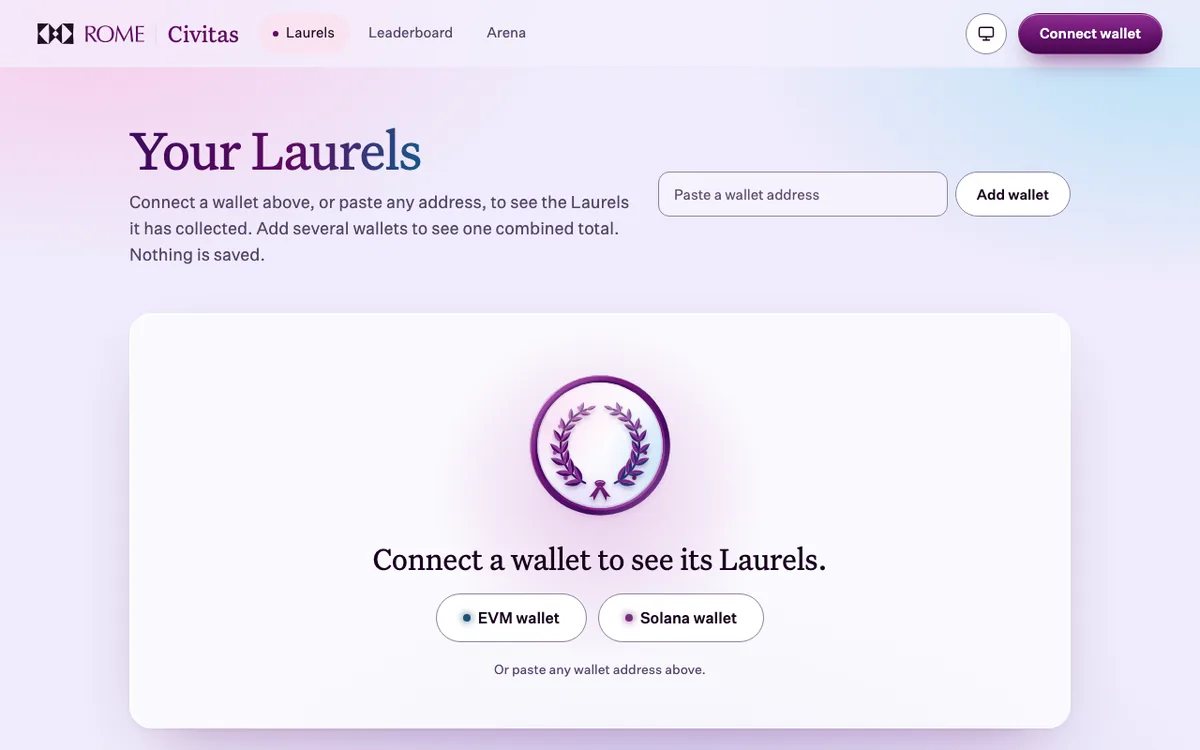
Civitas is the scoreboard: "Civitas records activity through Rome as Laurels associated with wallets." There is no sign-up, and anyone can look up any wallet. On 8 November 2026 its live settings counted:
- Rubicon: mainnet transactions.
- Portus: deposits, withdrawals and balances in Rome's USDC lending app.
- Rome Bridge: transfers to and from Rome.
- Imperia: holding one of Rome's NFTs, shown as an "Imperia bonus" on the days it applied.
- Arena: Laurels earned by builders and ambassadors.
Rome DEX is switched off for now. Testnet transactions are tallied per app, but "These counts are separate from mainnet Laurels."
Rome publishes no amounts per action, no start date and no end date. The Arena page archived on 6 March 2026 still showed events and hackathons, so Laurels are newer than that. Balances can move: "Rome may correct, recalculate, reset or remove Laurels and other records, including records of past activity."
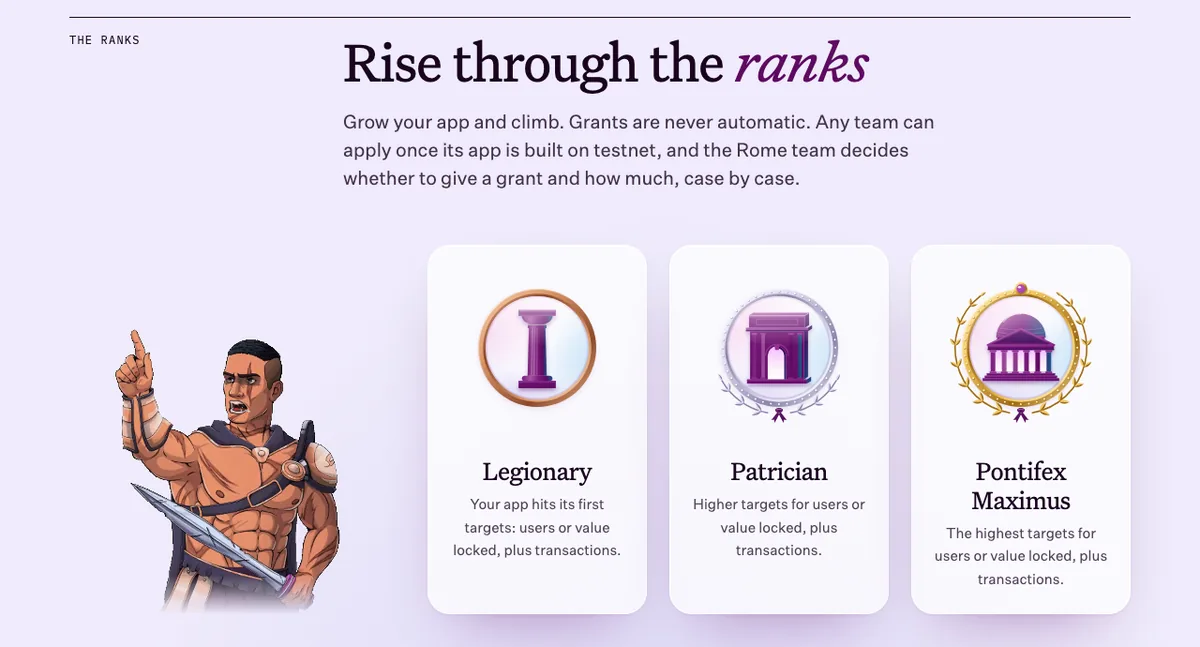
Arena is for builders and promoters: "Builders register their apps and link their contracts. Ambassadors log events, workshops, posts on X and the builders they bring. Both earn Laurels." Apps climb three ranks, Legionary, Patrician and Pontifex Maximus, by hitting targets for users or value locked plus transactions. "Grants are never automatic": a team can apply once its app is built on testnet, and Rome decides each case.
Rome Protocol airdrop step-by-step guide
Rome promises no airdrop. These steps get a wallet counted for Laurels.
- Open civitas.mainnet.romeprotocol.xyz/points and paste an EVM or Solana address, or connect a wallet. Up to 20 wallets can be combined.
- Practise free on Hadrian, the testnet, with test USDC from Circle's faucet, bridged in. It doesn't add to mainnet Laurels.
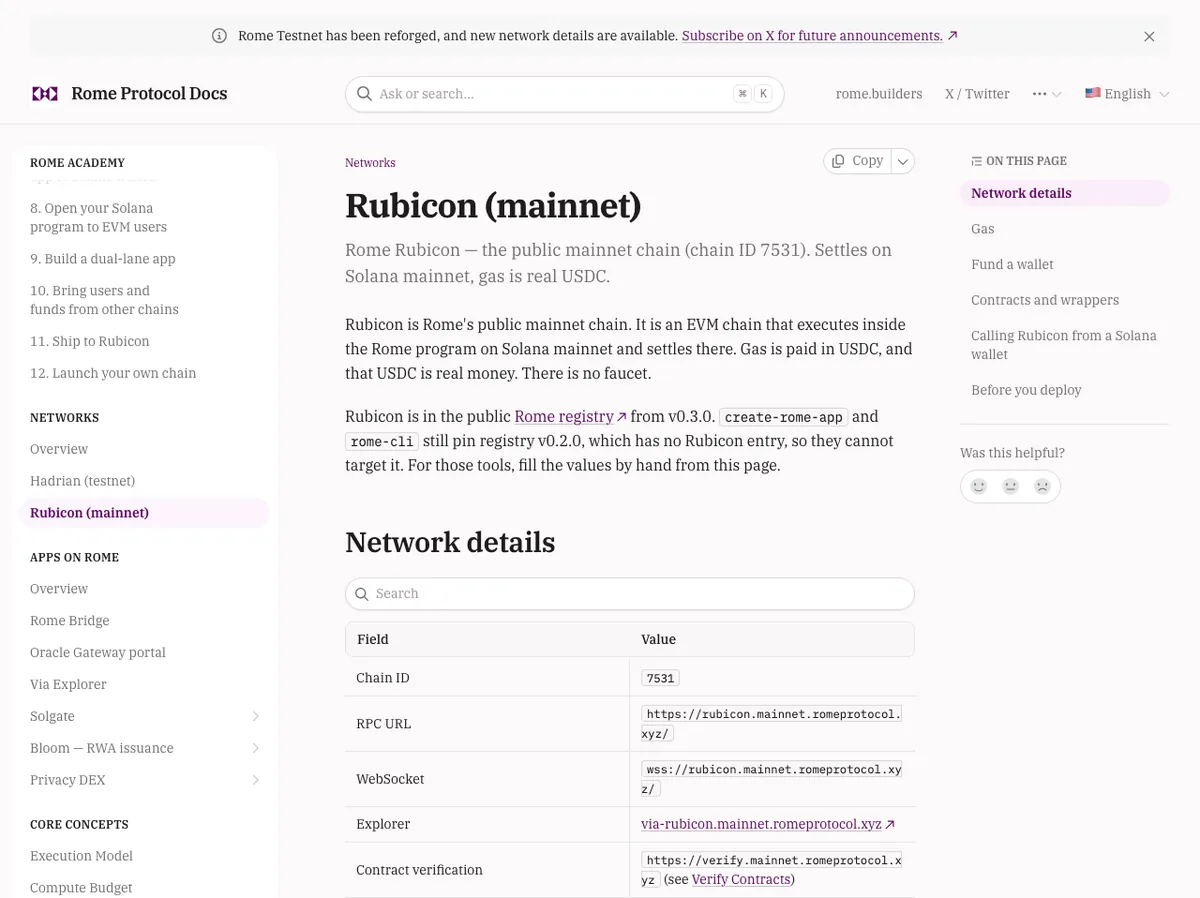
- Add Rubicon to MetaMask by hand: chain ID 7531, RPC https://rubicon.mainnet.romeprotocol.xyz/, symbol USDC. Rome warns: "Every transaction on Rubicon spends real USDC."
- Fund it with the mainnet Rome Bridge: USDC over CCTP from Ethereum, Base, Arbitrum, Polygon, Avalanche, Monad or OP, or SOL and USDC from a Solana wallet. "There is no faucet." The transfer itself counts.
- Use Portus: "Lend USDC in a Kamino market you choose and withdraw to the same wallet."
Warning Portus puts your USDC into a lending market on Solana, where a contract bug or market stress can cost you part of it. Lend only what you can afford to lose.
- If you build or promote, sign in to Arena with a wallet or email and pick a role. Ambassador posts on X must carry your Arena code. This route is free.
- Treat the Imperia NFT as optional: "Holding a Rome NFT does not create a right to Laurels, a bonus, a grant or a distribution." If you buy, use the link on rome.builders/imperia, because Rome says "we never DM links".
Check your Rome LaurelsOpens civitas.mainnet.romeprotocol.xyz
Rome Protocol costs and fees
Looking up Laurels and joining Arena are free. Everything counted on mainnet costs gas in real USDC, at a price the docs put at roughly ten times Hadrian's. They advise: "Fund at least 0.5 USDC of gas; 1 USDC leaves comfortable headroom." For builders, a first contract deploy "costs about 1.5 USDC at that price". Bridging in also costs gas on the source chain, and Rome publishes no bridge fee. Imperia NFTs sell on Magic Eden at market price, which we didn't check. We found no entry fee or minimum deposit.
Rome Protocol risks and eligibility
- Nothing is owed: "Laurels give you no right to tokens, payment, a grant or any other benefit." "Rome alone decides whether to make a distribution, who is eligible, the amount and the conditions."
- KYC: "Identity verification will be required at claim." Rome hasn't named the provider.
- Rome "may change, suspend or end Civitas, Arena or any programme they record."
- "You must be an adult with legal capacity to enter into these terms." There is no country list, only "Do not use the services where your participation is prohibited by law."
- "Using multiple wallets is not, by itself, prohibited." Using them to game the records is.
- We found no published audit of the core Rome EVM program, Portus or the bridge. "The Oracle Gateway has not been audited", and Ostia's code is unaudited too.
- Control is central: "Each Rome deployment is operated by a single entity (the payer pool operator)." The mainnet program has "multisig-governed upgrades".
Who is behind Rome Protocol?
Rome's official pages name no founders or executives. Two companies appear. The terms say "Rome Network Corp., a Panama corporation, operates Civitas and Arena", under Panama law. The website privacy policy names "Coin Vesting, Inc., a Delaware C-corporation doing business as Rome Protocol" as operator of the site and of Bloom, a separate real-world asset app.
On 9 July 2024 CryptoSlate reported that "Rome Protocol has secured $9 million in a funding round", naming Hack VC, Polygon Ventures, HashKey and others, plus angels including Solana co-founder Anatoly Yakovenko. Rome's homepage lists Hack VC as lead investor, with no amount. Its 2024 pitch, Solana as a shared sequencer for Ethereum rollups, has since changed.
Sources
- Rome Protocol Rome Protocol
- Live Apps Rome Protocol
- Arena Rome Protocol
- Imperia: Rome Citizens Rome Protocol
- Rome Arena Rome Arena
- Your Laurels Rome Civitas
- Civitas feature settings (what is counted) Rome Civitas,
- Terms for Civitas and Arena Rome Civitas
- Privacy notice for Civitas and Arena Rome Civitas
- Privacy Policy, Rome Protocol / Bloom Rome Protocol
- What is Rome? Rome docs
- One market Rome docs
- Networks overview Rome docs
- Rubicon (mainnet) Rome docs
- Hadrian (testnet) Rome docs
- Quickstart Rome docs
- Faucets Rome docs
- Rome Bridge Rome docs
- Oracle Gateway Rome docs
- Known Limitations Rome docs
- Ostia status and roadmap Rome docs,
- Ostia trust model and limits Rome docs
- Arena page, March 2026 (Wayback copy) Rome Protocol (Wayback copy),
- Rome Protocol secures $9 million to bring Solana capabilities to Ethereum Layer-2 CryptoSlate,
This guide explains how the program works. It isn't financial advice, and no airdrop is guaranteed. Check Rome Protocol's official channels before you connect a wallet or deposit funds.